| --- |
| license: bsd-3-clause |
| library_name: braindecode |
| pipeline_tag: feature-extraction |
| tags: |
| - eeg |
| - biosignal |
| - pytorch |
| - neuroscience |
| - braindecode |
| - foundation-model |
| - transformer |
| --- |
| |
| # CodeBrain |
|
|
| CodeBrain: Scalable Code EEG Pre-Training for Unified Downstream BCI Tasks. |
|
|
| > **Architecture-only repository.** Documents the |
| > `braindecode.models.CodeBrain` class. **No pretrained weights are |
| > distributed here.** Instantiate the model and train it on your own |
| > data. |
|
|
| ## Quick start |
|
|
| ```bash |
| pip install braindecode |
| ``` |
|
|
| ```python |
| from braindecode.models import CodeBrain |
| |
| model = CodeBrain( |
| n_chans=22, |
| sfreq=200, |
| input_window_seconds=4.0, |
| n_outputs=2, |
| ) |
| ``` |
|
|
| The signal-shape arguments above are illustrative defaults — adjust to |
| match your recording. |
|
|
| ## Documentation |
| - Full API reference: <https://braindecode.org/stable/generated/braindecode.models.CodeBrain.html> |
| - Interactive browser (live instantiation, parameter counts): |
| <https://huggingface.co/spaces/braindecode/model-explorer> |
| - Source on GitHub: <https://github.com/braindecode/braindecode/blob/master/braindecode/models/codebrain.py#L21> |
|
|
|
|
| ## Architecture |
|
|
| 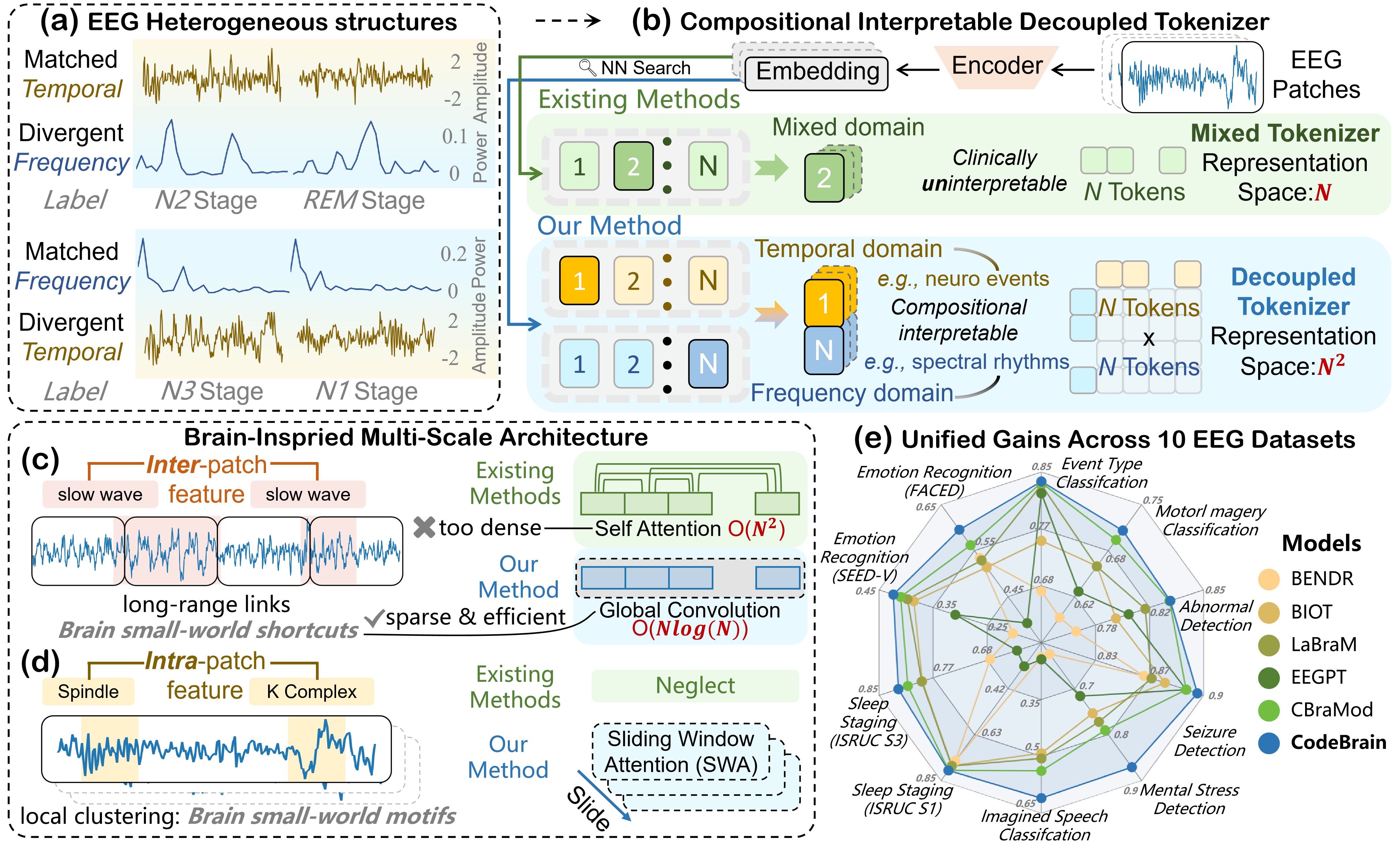 |
|
|
|
|
| ## Parameters |
|
|
| | Parameter | Type | Description | |
| |---|---|---| |
| | `patch_size` | int, default=200 | Number of time samples per patch. Input length is trimmed to the nearest multiple of `patch_size`. | |
| | `res_channels` | int, default=200 | Width of the residual stream inside each `ResidualBlock`. | |
| | `skip_channels` | int, default=200 | Width of the skip-connection stream aggregated across blocks. | |
| | `out_channels` | int, default=200 | Output channels of `final_conv` before the classification head. | |
| | `num_res_layers` | int, default=8 | Number of stacked `ResidualBlock` modules. | |
| | `drop_prob` | float, default=0.1 | Dropout rate used inside the `_GConv` SSM and attention layers. | |
| | `s4_bidirectional` | bool, default=True | Whether the `_GConv` SSM processes the sequence bidirectionally. | |
| | `s4_layernorm` | bool, default=False | Whether to apply layer normalisation inside the `_GConv` SSM. Set to `False` to match the released pretrained checkpoint. | |
| | `s4_lmax` | int, default=570 | Maximum sequence length for the `_GConv` SSM kernel. Also determines the patch embedding dimension as `s4_lmax // n_chans`. | |
| | `s4_d_state` | int, default=64 | State dimension of the `_GConv` SSM. | |
| | `conv_out_chans` | int, default=25 | Number of output channels in the patch projection convolutions. | |
| | `conv_groups` | int, default=5 | Number of groups for `GroupNorm` in the patch projection. | |
| | `activation` | type[nn.Module], default=nn.ReLU | Non-linear activation class used in `init_conv` and `final_conv`. | |
|
|
|
|
| ## References |
|
|
| 1. Yi Ding, Xuyang Chen, Yong Li, Rui Yan, Tao Wang, Le Wu (2025). CodeBrain: Scalable Code EEG Pre-Training for Unified Downstream BCI Tasks. https://arxiv.org/abs/2506.09110 |
|
|
|
|
| ## Citation |
|
|
| Cite the original architecture paper (see *References* above) and braindecode: |
|
|
| ```bibtex |
| @article{aristimunha2025braindecode, |
| title = {Braindecode: a deep learning library for raw electrophysiological data}, |
| author = {Aristimunha, Bruno and others}, |
| journal = {Zenodo}, |
| year = {2025}, |
| doi = {10.5281/zenodo.17699192}, |
| } |
| ``` |
|
|
| ## License |
|
|
| BSD-3-Clause for the model code (matching braindecode). |
| Pretraining-derived weights, if you fine-tune from a checkpoint, |
| inherit the licence of that checkpoint and its training corpus. |
|
|


