| --- |
| license: bsd-3-clause |
| library_name: braindecode |
| pipeline_tag: feature-extraction |
| tags: |
| - eeg |
| - biosignal |
| - pytorch |
| - neuroscience |
| - braindecode |
| - convolutional |
| --- |
| |
| # EEGITNet |
|
|
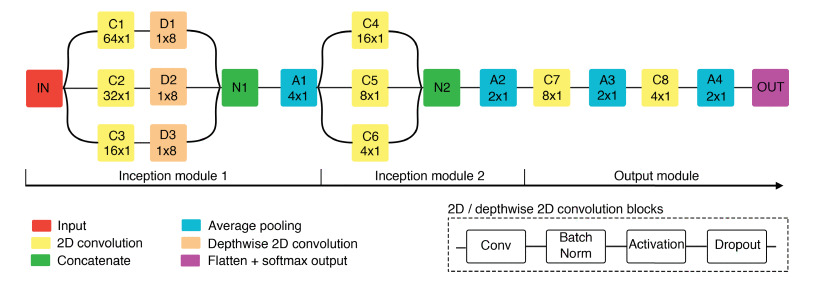
| EEG-ITNet from Salami, et al (2022) [Salami2022] |
|
|
| > **Architecture-only repository.** Documents the |
| > `braindecode.models.EEGITNet` class. **No pretrained weights are |
| > distributed here.** Instantiate the model and train it on your own |
| > data. |
|
|
| ## Quick start |
|
|
| ```bash |
| pip install braindecode |
| ``` |
|
|
| ```python |
| from braindecode.models import EEGITNet |
| |
| model = EEGITNet( |
| n_chans=22, |
| sfreq=250, |
| input_window_seconds=4.0, |
| n_outputs=4, |
| ) |
| ``` |
|
|
| The signal-shape arguments above are illustrative defaults — adjust to |
| match your recording. |
|
|
| ## Documentation |
| - Full API reference: <https://braindecode.org/stable/generated/braindecode.models.EEGITNet.html> |
| - Interactive browser (live instantiation, parameter counts): |
| <https://huggingface.co/spaces/braindecode/model-explorer> |
| - Source on GitHub: <https://github.com/braindecode/braindecode/blob/master/braindecode/models/eegitnet.py#L12> |
|
|
|
|
| ## Architecture |
|
|
|  |
|
|
|
|
| ## Parameters |
|
|
| | Parameter | Type | Description | |
| |---|---|---| |
| | `drop_prob: float` | — | Dropout probability. | |
| | `activation: nn.Module, default=nn.ELU` | — | Activation function class to apply. Should be a PyTorch activation module class like `nn.ReLU` or `nn.ELU`. Default is `nn.ELU`. | |
| | `kernel_length` | int, optional | Kernel length for inception branches. Determines the temporal receptive field. Default is 16. | |
| | `pool_kernel` | int, optional | Pooling kernel size for the average pooling layer. Default is 4. | |
| | `tcn_in_channel` | int, optional | Number of input channels for Temporal Convolutional (TC) blocks. Default is 14. | |
| | `tcn_kernel_size` | int, optional | Kernel size for the TC blocks. Determines the temporal receptive field. Default is 4. | |
| | `tcn_padding` | int, optional | Padding size for the TC blocks to maintain the input dimensions. Default is 3. | |
| | `drop_prob` | float, optional | Dropout probability applied after certain layers to prevent overfitting. Default is 0.4. | |
| | `tcn_dilatation` | int, optional | Dilation rate for the first TC block. Subsequent blocks will have dilation rates multiplied by powers of 2. Default is 1. | |
|
|
|
|
| ## References |
|
|
| 1. A. Salami, J. Andreu-Perez and H. Gillmeister, "EEG-ITNet: An Explainable Inception Temporal Convolutional Network for motor imagery classification," in IEEE Access, doi: 10.1109/ACCESS.2022.3161489. |
|
|
|
|
| ## Citation |
|
|
| Cite the original architecture paper (see *References* above) and braindecode: |
|
|
| ```bibtex |
| @article{aristimunha2025braindecode, |
| title = {Braindecode: a deep learning library for raw electrophysiological data}, |
| author = {Aristimunha, Bruno and others}, |
| journal = {Zenodo}, |
| year = {2025}, |
| doi = {10.5281/zenodo.17699192}, |
| } |
| ``` |
|
|
| ## License |
|
|
| BSD-3-Clause for the model code (matching braindecode). |
| Pretraining-derived weights, if you fine-tune from a checkpoint, |
| inherit the licence of that checkpoint and its training corpus. |
|
|


